Monday, November 17, 2014

Highlights from VSCONNECT - Day Two

One other announcements from Day One that got overshadowed by some of the major announcements.

Visual Studio 2015 Preview is available, which includes:
  •    a preview of .Net 2015
  •    a preview of ASP.Net 5
  •    an Android emulator for Visual Studio.
A pretty good summary of the preview is available here.

This slide was shown in a discussion of ASP.Net 5, but it's applicable to the broader .Net development environment.  The middle column represents the layers.  The left column represents .Net development prior to the VSCONNECT announcements.  The right column represents .Net development after the VSCONNECT announcements.


Note that platform specific sections of .Net are not being open sources (i.e., WPF).

Here's another important diagram from the announcements.


Which is a lot more comforting to .Net developers than their last rather famous diagram from Build in 2011.


There's some pretty good analysis of the announcements on iProgrammer here and here.


Wednesday, November 12, 2014

Highlights from VSCONNECT - Day One

While most people were watching a EAS land a probe on a comet, I was watching the first day of VSCONNECT.   It was a bit of information overload, but here's the main things I got:

  • Future versions of the .Net Framework will be named based on the year they are released.  For example, the next version will be called .Net 2015.
  • The source code for the .Net Framework will be open sourced.  The core portions of it are already available on Microsoft's GitHub server.
  • The core .Net Framework has been ported to Linux and OSX.
  • A new edition of VS.Net, called the community edition is now available free of charge to individual developers and small development groups.  It is not an express version of VS, but a full featured version that can be used for production development   Licensing is only required for "enterprise use".

More details on the announcements in day one can be found here and here.  Recordings of the webcast can be found here.

During the "halftime show" there were a lot of questions about the future of WPF.  That has been responded to in a blog post here.

Wednesday, September 10, 2014

Deploying PowerBuilder apps to desktops and mobile devices using Microsoft RemoteApp

Microsoft has recently announced a new feature of Windows Azure called RemoteApp that allows Windows applications to be hosted on Azure and then run via RDP on the desktop as well as mobile devices, including iOS and Android devices.  We're going to look to see how well that works for a PowerBuilder application.


Friday, July 18, 2014

Creating a REST web service using PowerBuilder.Net 12.5

One of the new features introduced with PowerBuilder.Net 12.5 was the ability to create WCF web services.  The version of the product also introduced a client for REST web services as well, and a WCF client had been introduce in an earlier version.  One frequent question I heard when presenting the new features in conference or online sessions was when PowerBuilder.Net would provide the capability to create REST services, not just consume them.

Perhaps what few people realized (including myself at the time) is that WCF web services isn't just for creating SOAP services.  Since .Net 3.0, they have been capable of creating REST services as well.  So we've actually have had the capability to create REST web services with PowerBuilder.Net since 12.5 was released.  In this blog post we'll look at how we do that.


Calling .Net Assemblies from PowerBuilder Classic Win32 via PowerShell

Recently someone asked me how they could get the output from PBDOM used from a PowerBuilder Classic Win32 application formatted with white space as PBDOM doesn't include it.  I gave them a number of options, particularlyMSXML through OLE Automation or using a .Net class like XmlTextWriter.  Normally if you were going to try to access a .Net assembly from a PowerBuilder Classic Win32 application, you would do it via a COM Callable Wrapper.  However, for something this simple I thought there had to be a more lightweight way to accomplish it.  One particular lighterweight way that occurred to be would be to have the application launch a Windows PowerShell script that would then use the .Net class in question.  We're going to look at an example of how that's done.


Thursday, May 15, 2014

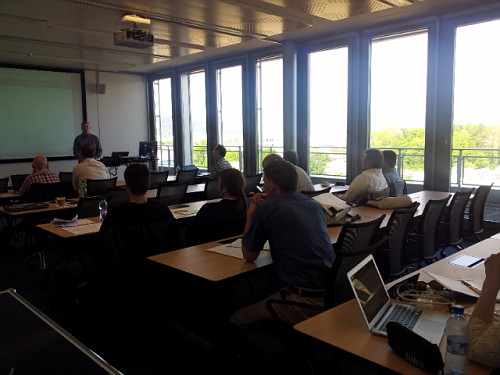
Swiss PowerBuilder User Group Meeting - May 5, 2014

The meeting was held as SAP's offices in Regensdorf, a suburb of Zurich.


The meeting started with Sue Dunnell and Dave Fish discussing the status of PowerBuilder, and in particular the beta.

  • 235 people signed up for beta.  Small for PB, but big for SAP
  • Other products are looking to follow same process, also complaining about S-user requirement

After that, Dave Fish demonstrated the following features in the beta version of PowerBuilder 15
  • OData
  • 64 bit support (Native)
  • Dockable Windows
  • HTML5 DataWindow
That was followed by my presentation on using visual controls (PB.Net in VS.Net, VS.Net in PB Classic).  We then broke for lunch.  After lunch, Jan Lemmens of SAP then gave an overview of application development with HANA.  After that, Dave Fish presenting SAPUI5 and OpenUI5.  Finally, Dave Fish demonstrated Android support in Appeon.


Thursday, May 01, 2014

Communication with a smart card from PowerBuilder

We're going to look at using the Smart Card SDK provided in more recent versions of Windows (XP and later).  Earlier versions of Windows had an ActiveX installed called CAPICOM which could be accessed from PowerBuilder through OLE Automation, but that control was removed as of Windows Vista because of security issues.

We're going to look at a number of operations: